
Drosophila Gene Collection
- DGC Release 1.0
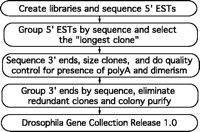 After careful analysis of over 80,000 ESTs to
find full-length cDNA clones, including verification of the 3' ends of these clones, we have selected 5,849
non-redundant cDNA clones for single colony purification and re-arraying (see What is
the Drosophila Gene Collection? for more information). This is not a complete set of genes for the Drosophila
genome, which has been reported to have 13,601 genes. Version 1.0 has been released as of August 2000 as bacterial
glycerol stocks in 384-well plates; it has also been released to others as plasmid DNA stocks in 96-well plates. The
stocks have been released to sites chosen by the Drosophila Board, as well as to distributors.
After careful analysis of over 80,000 ESTs to
find full-length cDNA clones, including verification of the 3' ends of these clones, we have selected 5,849
non-redundant cDNA clones for single colony purification and re-arraying (see What is
the Drosophila Gene Collection? for more information). This is not a complete set of genes for the Drosophila
genome, which has been reported to have 13,601 genes. Version 1.0 has been released as of August 2000 as bacterial
glycerol stocks in 384-well plates; it has also been released to others as plasmid DNA stocks in 96-well plates. The
stocks have been released to sites chosen by the Drosophila Board, as well as to distributors.
- DGC Release 2.0
With the completion of the 2001 EST project, we have now analyzed over 240,000 ESTs. Using new computational methods based upon the annotated genomic sequence, we have identified more than 5,000 new cDNA clones to add to the DGC. DGCr2.0 has been released as of February 2003 as bacterial glycerol stocks in 384-well plates. Here is the list of labs and distributors .
- DGC Release 3.0
Generation of the Release 3 annotation of the genome made extensive use of our full-insert sequence data. In the course of that effort, human curators identified a total of 1,860 clones that have become the DGCr3. The DGCr3 currently includes clones chosen to replace clones with truncated ORFs, clones for genes that are not currently represented in the DGC, plus clones that represent putative alternative splicing forms.
- DGC Release 4.0
A directed screen for clones capturing unrepresented genes in the collection has led to a set of 2,148 non-redundant clones. This set represents rare transcripts, many of which alter current annotations of the genome. Note that from the nature of this screen and the rarity of the transcripts, some of these clones represent only fragments of the presumed transcripts or have may have other artifacts.
- Drosophila Gold Collection
The DGC Gold collection is comprised of clones with verified full-length ORFs, and will be useful for proteomics and functional genomics.
DGCr1.0 Contents
-
Browse Hyperlinked tables of clones comprising the DGCr1.0 in 384-well plate (bacterial stock) format.
-
Browse Hyperlinked tables of clones comprising the DGCr1.0 in 96-well plate (DNA stock) format.
-
Download Single flat file/text table of clones comprising the DGCr1.0 organized by 384-well (bacterial stock) format.
-
Download Single flat file/text table of clones comprising the DGCr1.0 organized by 96-well (DNA stock) format.
-
Details of the DGCr1.0 Arrays
-
Overview DGCr1 Clone Arrays Wells with Exceptional Clones
DGCr2.0 Contents
- Download Single flat file containing the clones comprising the DGCr2.0.
- Labs that received DGCr2
DGCr3.0 Contents
- Download Single flat file containing the clones comprising the DGCr3.0.
DGCr4.0 Contents
- Download Single flat file containing the clones comprising the DGCr4.0.
Obtaining the DGC
- Materials Instructions for obtaining the DGC 1.0, DGC 2.0, or single cDNA clones in either release.
More Information
Single flat file in multiple fasta format of the EST sequences of the cDNA clones comprising the DGC. Size of file is 35.0 MB
Single flat file in multiple fasta format of all currently available full insert sequences of the cDNA clones comprising the DGC. Size of file is 20.7 MB
M Stapleton, J Carlson, P Brokstein, C Yu, M Champe, R George, H Guarin, B Kronmiller, J Pacleb, S Park, K Wan, GM Rubin and SE Celniker Genome Biology (2002) 3 (12):research0080.1-0080.8
M Stapleton, G Liao, P Brokstein, L Hong, P Carninci, T Shiraki, Y Hayashizaki, M Champe, J Pacleb, K Wan, C Yu, J Carlson, R George, S Celniker, and GM Rubin Genome Research (2002) 12 (8):1294-1300
G Rubin et. al., Science (2000) 287: 2222-2224.